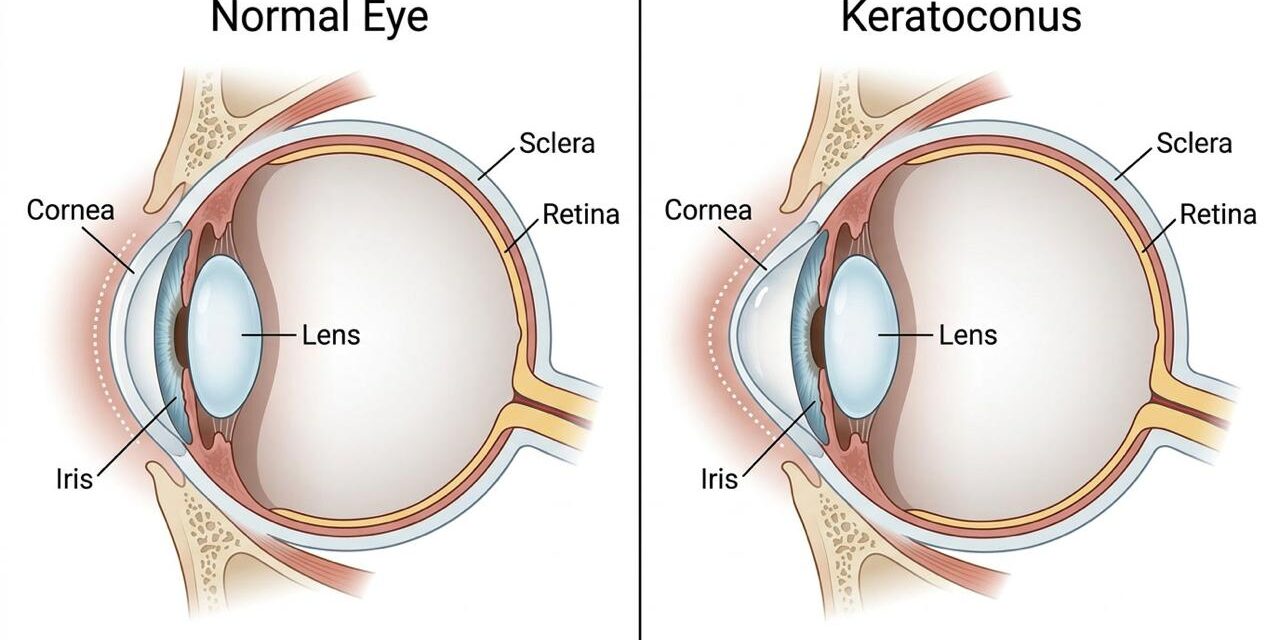
Keratoconus is a progressive degenerative corneal disease (the front, clear part of the eye), characterised by thinning of the corneal stroma (the thickest layer of the cornea) due to weakening of the collagen fibres. This results in an irregularly shaped cornea, instead of a more spherical shape, that in most cases cannot be corrected with regular spectacles.
What Does Keratoconus Cause?
This irregular shape of the cornea can result in:
Blurred or distorted vision
Halos around lights
Seeing wavy lines, especially at night
Light sensitivity
Extreme difficulty driving at night due to distortions from traffic lights and oncoming vehicles
High levels of regular astigmatism, later progressing to irregular astigmatism
Gradually, the blurred and distorted vision worsens over time if left untreated. In some cases, progression can be quite rapid.
When Should You Be Concerned?
If your astigmatic (cylinder) prescription increases every year, it may be advisable to undergo keratoconus screening.
This typically involves corneal tomography or topography, which are specialised scans that map the shape of the cornea. Early detection is especially important when keratoconus is still in its initial stages.
Why Does Keratoconus Occur?
The exact mechanism is not fully understood.
Genetics can play a role. If a family member has keratoconus, there is a possibility that you may develop it as well, even if your vision is not significantly affected at the moment. In such cases, screening is recommended.
One of the most commonly associated factors, both in literature and clinical practice, is eye rubbing.
Why Do We Rub Our Eyes?
It may seem simple to just stop rubbing your eyes, but if there is an underlying cause, that cause needs to be addressed rather than simply resisting the urge.
Some people assume they rub their eyes due to tiredness. There is a physiological response known as the ocular-cardiac reflex, where rubbing the eyes can slow the heart rate, which may feel relaxing.
However, eye rubbing can be extremely damaging and is often done unconsciously. It may be helpful to ask a friend or colleague if they notice you rubbing your eyes frequently.
Common Causes of Eye Rubbing
The most common reason for excessive eye rubbing is allergic eye disease, including:
Allergic conjunctivitis
Vernal keratoconjunctivitis
These are often linked to broader allergic conditions.
If you suffer from sinus issues such as postnasal drip or hay fever, the same allergens may also affect your eyes.
It is also possible to have eye allergies in isolation, even without sinus symptoms.
Dry eyes can also contribute to eye rubbing.
If you find that you frequently rub your eyes, it is advisable to consult your optometrist to determine the underlying cause.
Why Is It Important to Be Vigilant?
Keratoconus is progressive and degenerative. Ignoring it can have serious consequences for your vision.
In advanced cases, patients may lose the ability to function without specialised lenses, and in severe cases, a corneal transplant may be required.
Early Intervention: Corneal Cross-Linking
The advantage of early detection is that intervention is possible.
An ophthalmologist can perform a procedure called corneal cross-linking. In this procedure, a special form of Vitamin B is applied to the eye, followed by controlled exposure to ultraviolet light. This causes the collagen fibres in the cornea to strengthen through cross-linking.
This treatment does not reverse existing damage but can significantly slow or halt progression.
In clinical experience, progression after cross-linking is rarely observed.
Early treatment helps prevent the condition from becoming severe and impacting quality of life.
Can Cross-Linking Be Done in Advanced Cases?
Cross-linking can also be performed in more advanced stages of keratoconus. However, in extreme cases where the cornea has become too thin, the procedure may no longer be possible.
Diagnosed With Keratoconus: What Happens Next?
Management depends on the stage of the condition.
Early-stage keratoconus may still be managed with spectacles.
In more advanced cases, spectacles are no longer effective, and specialised contact lenses are required, including:
Rigid Gas Permeable (RGP) lenses
Scleral lenses
These lenses vault over the cornea and, together with the tear film, create a smooth optical surface, often restoring functional vision.
In severe cases, a corneal transplant may be necessary.
A Personal Perspective
During my time at university, we often saw advanced cases of keratoconus in the clinic.
In many instances, it was incredibly rewarding to see the difference specialised lenses made. Patients who had not seen clearly for a long time were able to regain functional vision.
Many of these patients came from disadvantaged communities, and families would often contribute together to afford the lenses.
However, there was one case that has stayed with me.
A young and capable man was unable to work due to his condition. The lenses that could have enabled him to function again were simply unaffordable for him.
It was a difficult reminder that access to care can be just as important as the treatment itself.
FAQ SECTION
What is keratoconus
Keratoconus is a progressive eye condition where the cornea becomes thin and irregularly shaped, leading to distorted vision.
What are the early signs of keratoconus?
Early signs include blurred vision, increasing astigmatism, halos around lights, and difficulty seeing at night.
What causes keratoconus
The exact cause is unknown, but genetics and chronic eye rubbing are strongly associated with the condition.
Can keratoconus be treated?
Keratoconus cannot be reversed, but treatments such as corneal cross-linking can slow or stop progression.
When should I get tested for keratoconus?
If your astigmatism increases frequently or your vision becomes distorted, you should consider a keratoconus screening.
Call us Today
If you are experiencing changes in your vision, particularly increasing astigmatism or distortion, it is important to seek professional evaluation.
Early detection and intervention can significantly reduce the risk of long-term vision impairment.