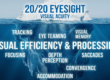
While glasses can make you see clearly, they are not always the complete solution for every visual challenge. In some cases, choosing the right design of lenses—such as accommodative support lenses, which offer extra power for near work, or adding prism lenses to correct eye alignment—can help make vision more comfortable. But there are situations where glasses simply aren’t enough, and vision therapy becomes necessary.
What Is Vision Therapy?
Vision therapy is a highly effective treatment for various eye conditions, particularly those related to how well your eyes work together as a team. Conditions like convergence insufficiency, divergence excess, and binocular vision instability require specialised exercises to train the eyes to function more efficiently.
In vision therapy, we do orthoptic exercises (eye exercises) like pencil push-ups (which can be done at home) and more advanced exercises with specialised equipment at our office. These exercises are designed to train your eyes to work together in a coordinated way, improving your ability to do near work, excel in sports, and perform other tasks that rely on strong visual skills.
Strengthening the Brain-Eye Connection
Vision therapy is not just about training the eyes—it also helps strengthen the connection between the brain and the eyes. Your eyes gather light and send signals to the brain, where that information is processed. Sometimes, the pathways from the eyes to the brain can be weak or underdeveloped, affecting how well you see and process visual information.
Vision therapy helps improve these pathways, making it an excellent treatment for conditions like amblyopia (lazy eye), where one or both eyes don’t see as clearly as they should. By retraining the brain and eyes to work together, vision therapy can help improve visual clarity and efficiency.
Can Vision Therapy Help with All Visual Challenges?
Unfortunately, vision therapy isn’t a cure for all visual conditions. For example, it may not be effective for conditions like visual stress, where the brain’s processing of visual information becomes overactive, or for issues like visual snow. However, at our practice, we are committed to doing our best to make your vision as comfortable and efficient as possible.
Signs That You May Benefit from Vision Therapy
If you experience any of the following symptoms, you may be a good candidate for vision therapy:
- Eye strain or the feeling that your eyes are pulling, especially after school or work
- Frequent headaches, particularly at the sides or front of your head
- Double vision, where you see two of the same object
- Amblyopia (lazy eye), where one eye doesn’t see as clearly as the other
- Strabismus (squint or eye turn), where one or both eyes are not aligned properly
- If your child struggles with schoolwork, particularly if they cry or fight about doing homework
- If you want to improve sports performance
- If you want to enhance your work performance
How Vision Therapy Can Improve Your Life
Whether you’re a student struggling with homework, an athlete looking to improve your performance, or someone dealing with eye strain at work, vision therapy can be an effective solution. It focuses on improving how your eyes and brain work together to provide clearer, more comfortable vision.
Book Your Eye Exam and Explore Vision Therapy
Our practice specialises in general optometry, paediatric optometry, and vision therapy. If you or your child are experiencing any of the symptoms listed above, come for an eye examination. We will assess whether orthoptic exercises and vision therapy are your options. Let us help you improve your visual comfort and performance.