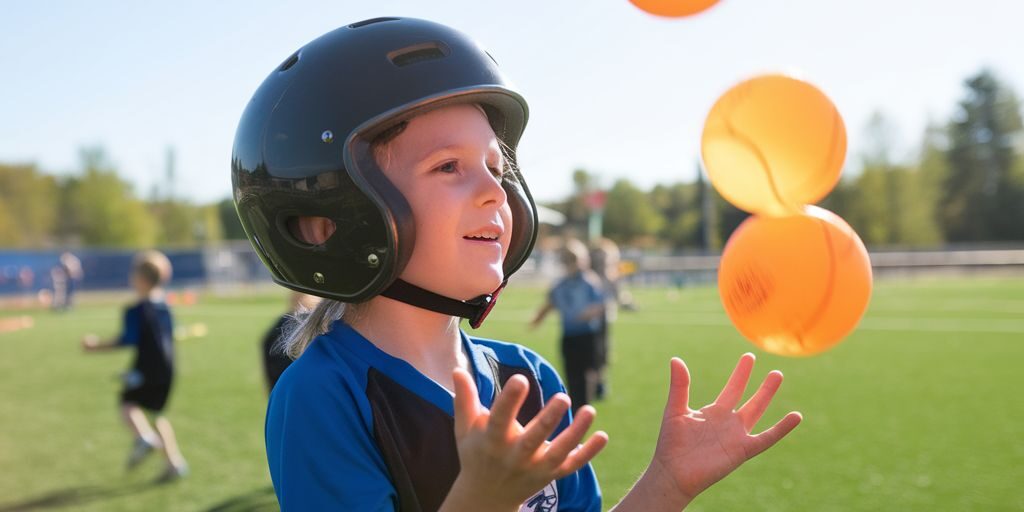
I’ve always struggled with ball skills. As a child, I avoided them at all costs, which unfortunately led to a lot of ridicule from the other boys. Back then, I assumed it was because I lacked talent and wasn’t cut out for sports. No one encouraged me to practice or improve my ball skills, so I resigned myself to thinking that sports just weren’t for me.
A Realisation About Visual Skills
Now, as an optometrist who specialises in visual development and vision therapy, I’ve come to realise that my poor performance in ball sports wasn’t due to a lack of talent or interest. It was due to unaddressed binocular vision issues that should have been identified and treated when I was younger. Unfortunately, we didn’t have a vision therapist in our hometown back then.
My struggles with ball skills were rooted in several visual deficiencies:
- Poor spatial awareness
- Poor fixation
- Poor depth perception
- Poor hand/foot/knee-eye coordination
These are all critical skills that should be developed in all children. They need to be actively encouraged and nurtured through active play from a very young age. Visual development is not a passive process—it requires engagement and practise.
The Importance of Ball Skills in Childhood
Every child needs to develop a certain level of ball skills. They don’t need to be Olympic athletes, but playing ball games is crucial for developing visual skills that go far beyond just sports. Activities like catching, throwing, and kicking a ball help children improve their coordination, spatial awareness, and depth perception—all of which are essential for everyday life.
Had I had access to vision therapy as a child, I believe my ball skills could have improved significantly. For children and adults alike, vision therapy can make a substantial difference, especially for those with a passion for sports.
Vision Therapy for Athletes: Enhancing Performance
If you’re a sports enthusiast, ask yourself: do you play very well sometimes and very poorly at other times? Do you miss your target frequently despite practising diligently? These inconsistencies might be due to underlying visual issues that haven’t been addressed, such as the need for glasses or vision therapy to optimise your performance.
Serious athletes often focus on the right diet, strict exercise routines, and adequate sleep. But how often do athletes or trainers consider the importance of optimising vision? Perhaps they only think about correcting farsightedness, shortsightedness, or astigmatism. However, vision is far more complex than that.
Beyond Clarity: Training Your Vision
Training vision through vision therapy can take a good athlete and make them even better. At our practice, we address visual issues that go beyond just clarity of vision. We focus on how well your eyes work as a team and how we can improve that coordination. The better your eyes work together, the better your performance will be.
The Role of Vision in Everyday Life
Whether you’re an athlete or not, ball skills remain important. If you or your child struggles with ball skills or wants to perform better in sports, a full comprehensive binocular vision exam and vision therapy may be the right path. These visual skills are essential for sports and everyday tasks requiring coordination and spatial awareness.
Take the Next Step: Book a Vision Evaluation
Our practice specialises in general optometry, family optometry, paediatric optometry, and vision therapy. If you suspect that visual issues might be affecting your or your child’s performance in sports or daily activities, we encourage you to book a comprehensive eye evaluation. Let us help you enhance your vision and improve your life.