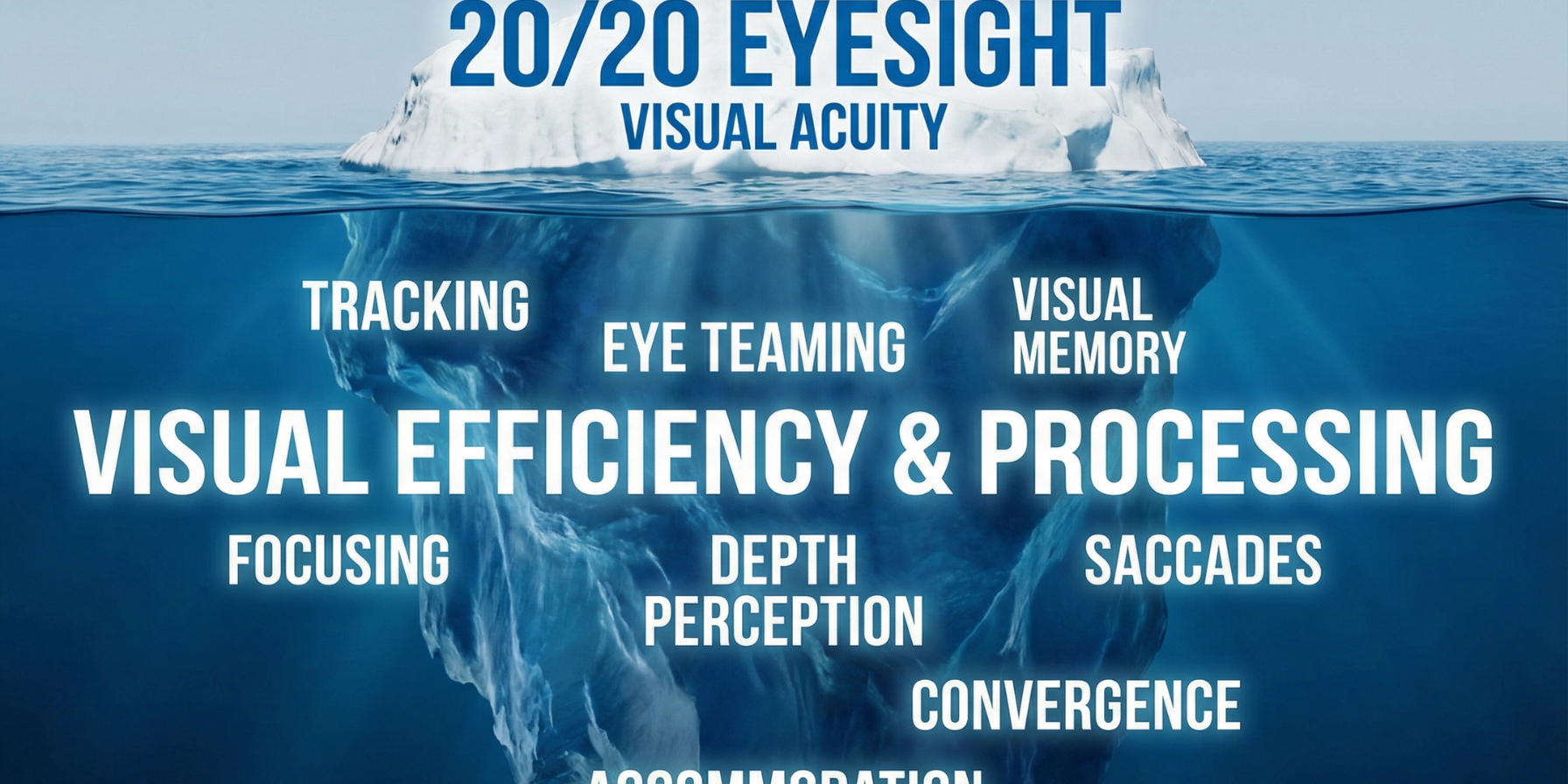
According to the American Optometric Association, vision-related learning difficulties can broadly be divided into two main areas: visual efficiency and visual information processing.
Understanding the difference between these two areas is crucial for understanding why a child may be struggling at school, despite appearing intelligent and motivated.
Visual Efficiency: The Foundation of Vision
Visual efficiency refers to the basic physiological functions of the visual system, including:
- Visual acuity: How clearly you see and whether spectacles are needed.
- Accommodation: The focusing ability of the lens inside the eye.
- Vergence: How well the eyes move inwards and outwards together as a team.
- Ocular motility: How accurately the eyes track moving targets.
These are the building blocks of comfortable, sustained vision. When any of these systems are under strain or not functioning optimally, learning becomes significantly harder.
Visual Information Processing: How the Brain Makes Sense of What We See
Visual information processing refers to how the brain interprets and uses visual information. This includes higher-order executive functions such as:
- Visual memory and visual sequential memory
- Visual form constancy
- Visual discrimination
- Pattern recognition
- Visual-motor integration
- Visual-spatial integration
- Visual-auditory integration
- Visual attention
- Figure-ground skills, etc.
These skills allow a child not just to see, but to understand, remember, organise, and act on what they see.
A Common Real-Life Example Parents Will Recognise
Ask yourself this question: Have you ever asked your child to fetch something from a cupboard, only for them to return saying they can’t find it, even though it was right in front of them?
This can be a figure-ground difficulty. The cupboard is visually cluttered, and the child struggles to visually isolate one object from all the visual noise in the background.
Common Signs of Visual Processing Difficulties
Children with visual processing challenges may:
- Dislike or struggle with puzzles.
- Avoid or find word searches very difficult.
- Confuse + and − signs in maths or skip questions unintentionally.
- Learn better by listening rather than reading or writing.
- Show poor or inconsistent sports performance (visual-motor integration).
These are often misinterpreted as a lack of effort, poor concentration, or behavioural issues.
“But They Have 20/20 Vision…”
A statement I hear far too often in practice is: “We were told nothing is wrong because their eyesight is perfect.”
Having 20/20 vision does not mean a child’s visual system is functioning efficiently. If accommodation, eye teaming, tracking, or visual processing are not assessed, significant visual difficulties can be missed entirely. Visual efficiency and visual processing cannot be separated; if one is compromised, the other will be affected.
Symptoms of Poor Visual Efficiency
Children (and adults) with poor visual efficiency may experience:
- Constant or intermittent blurry vision
- Double vision
- Eye strain or headaches
- Slow reading or losing their place while reading
- Poor, inconsistent, or skewed handwriting
- Reading the same line repeatedly
- Writing slowly or inaccurately from the board
- Procrastination, resistance, fighting, or crying about homework, etc.
These symptoms are often blamed on behaviour rather than vision.
The Digital Age Has Increased Visual Demand
With the digital revolution, visual efficiency has become more important than ever. Tablets, laptops, smartboards, and prolonged near-workplace massive visual demands on developing visual systems. When visual efficiency is not adequate, learning can become exhausting and frustrating very quickly.
Vision and Development Go Hand in Hand
Vision leads development. Deficiencies in both visual efficiency and visual information processing can lead to developmental delays.
That is why regular eye examinations are essential, even when no obvious problems are suspected. In our practice, we see children as young as 6 months of age. A comprehensive visual examination is recommended:
- At 6 months
- At 3 years
- Just before starting Grade 1
Early detection truly makes a difference.
Vision-Related Difficulties vs Learning Disabilities
Vision-related learning difficulties can sometimes be mistaken for learning disabilities. While the two can co-occur, they are not the same. Research suggests that up to 20% of individuals with learning disabilities also have an undiagnosed visual efficiency issue.
For this reason, best practice dictates that a full, comprehensive paediatric eye evaluation should be done first when a learning disability is suspected.
Why Vision Must Be Ruled Out First
Imagine a child experiencing intermittent blur or double vision. They will read inaccurately, slowly, and with great effort. This can look like a reading disorder, when in reality it is a visual efficiency problem. Vision should always be ruled out before labels are applied.
Never Assume, Never Stereotype
Learning difficulties occur equally across genders. Boys and girls should never be stereotyped as lazy, disruptive, or inattentive without a thorough evaluation. Every child deserves to be seen, understood, and supported.
Our Approach
At our practice, we take vision seriously. We assess not only whether a child can see clearly, but how their visual system functions as a whole. If visual challenges are identified, we explore appropriate solutions, whether that is spectacles, vision therapy, or collaborative care with other professionals.
Call to Action
If your child is struggling at school, avoiding reading, or showing signs of visual discomfort, a full comprehensive paediatric eye examination is an essential first step. Early intervention can change a child’s entire educational journey.
FAQ
What are vision-related learning difficulties?
Vision-related learning difficulties occur when visual efficiency or visual processing skills are impaired, making reading, writing, attention, and learning more difficult.
Can a child have learning difficulties with 20/20 vision?
Yes. Clear eyesight does not guarantee efficient eye teaming, focusing, tracking, or visual processing.
Should vision be tested before diagnosing a learning disability?
Yes. Best practice recommends a full, comprehensive paediatric eye evaluation before diagnosing a learning disability.
At what age should children have eye examinations?
At 6 months, 3 years, before Grade 1, and annually thereafter.
Can vision therapy help learning difficulties?
Vision therapy can significantly improve visual efficiency and processing when these systems are contributing to learning challenges.